
USA Vacs Expert Guide
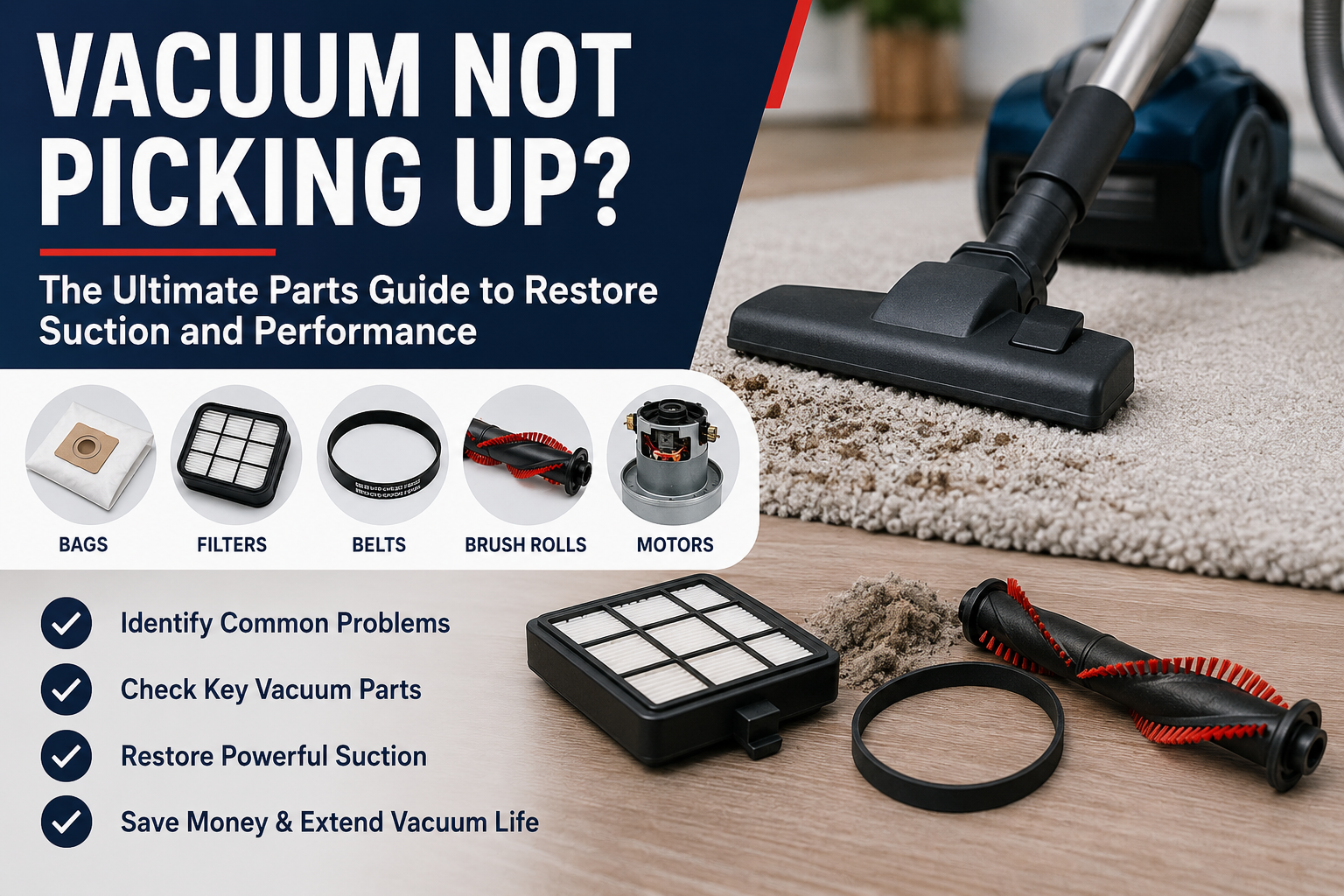
Vacuum Not Picking Up? The Complete Guide to Suction, Bags, Filters, Belts, Brush Rolls & Motors
When a vacuum stops picking up dirt, hair, crumbs, or carpet debris, most people assume the machine is worn out. Sometimes it is — but many times the vacuum simply needs the right maintenance part.
A full bag, clogged filter, stretched belt, worn brush roll, blocked hose, leaking seal, or weak motor can all make a vacuum act like it has no suction. This guide walks you through what to check first, what the symptoms mean, and when it makes sense to repair your vacuum instead of replacing it.
Quick Guide
- Quick answer: why your vacuum is not picking up
- Symptom chart: what to check first
- 1. Full or wrong vacuum bag
- 2. Dirty, clogged, or missing filter
- 3. Worn or broken vacuum belt
- 4. Hair-packed or worn brush roll
- 5. Clogs in the hose, wand, elbow, or base
- 6. Weak motor or airflow leak
- When to repair and when to replace
- Recommended vacuums if yours is not worth fixing
- Find the right vacuum part
- FAQ
Quick Answer: Why Is My Vacuum Not Picking Up?
A vacuum usually stops picking up because airflow is blocked or the brush roll is not moving dirt into the airflow path. Suction and pickup are connected, but they are not the same thing. A vacuum can have strong suction at the hose and still fail on carpet if the belt is slipping or the brush roll is worn. It can also have a spinning brush roll and still lose suction if the bag, filter, hose, or motor pathway is clogged.
If you know your model number or part number, use the USA Vacs Vacuum Parts A–Z search. If you are not sure which part fits, contact USA Vacs before ordering so we can help match the correct part.
Vacuum Troubleshooting Chart: What to Check First
| Problem | Most Likely Cause | What to Check | USA Vacs Link |
|---|---|---|---|
| Vacuum has weak suction everywhere | Full bag, dirty filter, clog, or motor issue | Bag, filter, hose, wand, inlet, motor sound | Parts & Accessories |
| Hose has suction but floor head does not pick up | Belt or brush roll problem | Brush roll spin, belt tension, hair buildup | Vacuum Belts |
| Vacuum smells hot or sounds strained | Clog, packed filter, jammed brush roll, slipping belt | Turn off and unplug; check airflow path and brush roll | Vacuum Filters |
| Vacuum leaves hair on carpet | Brush roll not agitating properly | Brush bristles, belt, height setting, pet hair wrap | Brush Rolls |
| Bagged vacuum loses power quickly | Wrong bag, low-quality bag, overfilled bag, clogged filter | Bag type, bag seal, pre-motor filter, exhaust filter | Vacuum Bags |
| Vacuum motor runs but pickup is poor after new parts | Air leak, cracked hose, worn gasket, tired motor | Hose cracks, seals, motor airflow, nozzle housing | Vacuum Motors |
1. A Full, Wrong, or Poor-Fitting Vacuum Bag Can Kill Suction
On a bagged vacuum, airflow has to move through the bag before it exits through the filter system. If the bag is full, clogged with fine dust, installed incorrectly, or the wrong style for the machine, suction can drop fast.
Signs the bag is the problem
- The vacuum sounds louder or more strained than normal.
- The machine picks up for a few minutes and then loses power.
- Dust leaks inside the bag chamber.
- The bag looks only half full but feels packed with fine dust, pet hair, carpet powder, or drywall dust.
- The bag collar does not seal tightly to the vacuum opening.
What to do
Replace the bag before it is packed solid. Make sure the bag collar locks into place and matches your exact brand, model, or part number. A bag that “almost fits” can leak dust into the motor area and cause bigger problems later.
Shop Vacuum Bags2. Dirty Filters Are One of the Most Common Reasons a Vacuum Loses Power
Filters protect the motor and help control dust, but they can also restrict airflow when they are packed with dirt. Many vacuums have more than one filter: a pre-motor filter, exhaust filter, HEPA filter, charcoal filter, foam filter, or cartridge filter.
Signs the filter is the problem
- The vacuum has suction for a short time and then overheats.
- The vacuum smells dusty or stale when running.
- The filter looks gray, black, fuzzy, or packed with fine powder.
- The vacuum has weak suction even with an empty bag or bin.
- Dust puffs out of the machine.
What to do
Check your owner’s manual or filter label. If the filter is washable, let it dry completely before reinstalling. If the filter is disposable, damaged, misshaped, or smells bad, replace it.
Shop Vacuum Filters3. A Vacuum Belt Can Look Fine but Still Slip
If your vacuum has suction at the hose but will not pick up from the floor, the belt is one of the first things to check. A stretched belt may still be in one piece, but it may not spin the brush roll with enough force to clean carpet.
Signs the belt is the problem
- The brush roll does not spin.
- The brush roll spins slowly or stops when it touches carpet.
- You smell burning rubber.
- The vacuum is hard to push or skips across the carpet.
- The machine leaves dirt behind even though the hose has suction.
What to do
Unplug the vacuum, remove the bottom plate, and inspect the belt. If it is cracked, loose, shiny, stretched, melted, or missing, replace it with the exact belt made for your model.
Shop Vacuum Belts4. A Worn or Hair-Packed Brush Roll Can Make a Good Vacuum Clean Poorly
The brush roll digs into carpet, lifts hair, and moves debris into the airflow path. When the bristles are worn down or the ends are jammed with hair, the vacuum may still turn on but leave the carpet looking dirty.
Signs the brush roll is the problem
- Pet hair stays on the carpet after vacuuming.
- The brush roll is wrapped with hair, string, thread, or carpet fiber.
- The bristles feel soft, short, uneven, or melted.
- The brush roll makes grinding or rattling noises.
- The belt keeps breaking because the brush roll is hard to turn.
What to do
Cut away wrapped hair carefully, then spin the brush roll by hand. It should turn freely. If the bearings are noisy, the bristles are worn flat, or the brush roll is damaged, replacing it can make a major difference.
Shop Vacuum Brush Rolls5. Clogs Hide in More Places Than People Think
A vacuum clog is not always in the hose. It can be in the wand, elbow, lower nozzle, dirt tube, bag opening, powerhead neck, central vacuum inlet, or where the hose connects to the machine.
Common clog locations
- At the base of an upright vacuum, right behind the brush roll.
- Inside the hose where it bends near the handle.
- Inside a wand or telescoping tube.
- At the bag collar or dirt inlet.
- Inside a canister powerhead neck.
- At the wall inlet or hose connection on a central vacuum system.
For more step-by-step suction troubleshooting, read our related guide: How to Fix a Vacuum With Low Suction.
6. When the Motor Is the Problem
If the bag, filters, belt, brush roll, hose, and seals all check out, the issue may be deeper. A weak motor, worn carbon brushes, damaged fan, bad thermal protector, or air leak can make a vacuum act like it has no power.
Signs the motor may need service
- The vacuum smells electrical or runs extremely hot.
- The motor tone changes, surges, or sounds rough.
- The vacuum shuts off and only restarts after cooling down.
- There is weak suction even with the hose removed and filters checked.
- You see sparks, smoke, or black dust near the motor area.
Need a motor or repair part?
USA Vacs carries vacuum motors and many repair parts for residential, commercial, and central vacuum systems. Matching the exact model number, motor number, or part number is important.
Shop Vacuum Motors Ask Us to Help Match a MotorShould You Repair the Vacuum or Replace It?
Not every vacuum is worth fixing, but many are. A quality SEBO, Riccar, Oreck, commercial upright, canister vacuum, lightweight upright, or central vacuum system can often be repaired with the correct bag, filter, belt, brush roll, hose, powerhead part, or motor.
| Repair Usually Makes Sense When... | Replacement May Make More Sense When... |
|---|---|
| The vacuum is a quality brand and only needs bags, filters, belt, hose, brush roll, or powerhead repair. | The vacuum is low-cost, heavily worn, cracked, missing parts, or has repeated electrical issues. |
| The motor is available and the rest of the machine is in good shape. | The cost of repair is close to the price of a better new machine. |
| You like how the vacuum cleans and replacement parts are still available. | The vacuum never cleaned well for your carpet, pet hair, allergies, or home layout. |
| You own a premium canister, premium upright, lightweight upright, central vacuum, or commercial vacuum. | You have a disposable-style machine with poor parts support. |
Recommended Vacuums If Yours Is Not Worth Fixing
If your vacuum is worn out, has poor parts support, or was never a good fit for your home, replacing it with a better machine can save money over time. Below are several USA Vacs options we often point shoppers toward based on cleaning needs.

SEBO E3 Premium
A premium canister vacuum for homes that need strong carpet cleaning plus smooth hard-floor performance. A great choice for people who want a long-term machine instead of a disposable vacuum.
View SEBO E3
Riccar SupraLite R17
A premium lightweight upright for carpet cleaning, pet hair, and everyday use. Good for shoppers who want strong pickup without pushing a heavy vacuum.
View Riccar R17
Riccar R30D
A full-size upright vacuum for homes that need deep carpet cleaning, filtration, and above-floor cleaning reach.
View Riccar R30D
Riccar R10E
A simple, lightweight upright for users who want strong carpet pickup without overcomplicating the machine.
View Riccar R10E
Lightweight Vacuums
Shop lightweight vacuums for easier carrying, quicker daily cleaning, and strong carpet pickup without the bulk of a heavy full-size machine.
Shop Lightweight Vacuums
Parts Before Replacement
If your vacuum is still a good machine, the better move may be replacing the bag, filter, belt, brush roll, hose, or motor.
Shop PartsMore USA Vacs vacuum links
- Shop Lightweight Vacuums
- SEBO Automatic X7 Premium Graphite Upright Vacuum
- Search USA Vacs for SEBO X4 vacuums
- SEBO AirBelt D4 Premium Canister Vacuum, White
- Riccar SupraLite Premium Lightweight Vacuum R10P
- Riccar SupraLite R10CV Cordless Vacuum
- Riccar Tandem Air Premium Pet Vacuum R40P.8
- Shop all vacuum cleaners
- Shop commercial vacuums
Find the Right Vacuum Part at USA Vacs
The most important thing with vacuum parts is matching the exact model number, part number, or bag/filter/belt style. Two parts can look similar online but fit differently in the machine.
Vacuum Bags
For bagged uprights, canisters, commercial vacuums, and central vacuum systems.
Shop BagsVacuum Filters
HEPA filters, pre-motor filters, exhaust filters, foam filters, cartridge filters, and more.
Shop FiltersVacuum Belts
Replacement belts for uprights and powerheads when the brush roll stops spinning correctly.
Shop BeltsBrush Rolls
Replace worn, damaged, noisy, or hair-packed brush rolls to restore carpet pickup.
Shop Brush RollsVacuum Motors
Replacement motors and motor-related parts for many residential, commercial, and central vacuums.
Shop MotorsParts A–Z
Search by brand, model number, part number, or part type if you already know what you need.
Search Parts A–ZHow to Keep Your Vacuum Picking Up Like It Should
- Replace bags before they are packed tight.
- Check filters regularly, especially in homes with pets, carpet powder, fine dust, or allergies.
- Remove hair and thread from the brush roll before it damages the belt or bearings.
- Do not vacuum wet debris, large objects, sharp items, ashes, or construction dust unless your machine is designed for it.
- Use the right height setting on carpet.
- Check hoses and wands for clogs when pickup suddenly drops.
- Use genuine or properly matched replacement parts whenever possible.
Better maintenance helps protect your motor, keeps airflow moving, and can make your vacuum last longer. If your machine is worth keeping, the right part can bring it back to life.
FAQ: Vacuum Not Picking Up
Why does my vacuum have suction at the hose but not pick up from the floor?
That usually points to the floor head, brush roll, belt, height setting, or lower nozzle. Check whether the brush roll spins strongly when the vacuum is on. If it stops on carpet, the belt may be stretched or the brush roll may be jammed.
Can a dirty filter make a vacuum lose suction?
Yes. A clogged filter blocks airflow and can make the vacuum run hot, sound strained, smell dusty, or shut off. Replace disposable filters and only wash filters if the manufacturer says they are washable.
How do I know if my vacuum belt is bad?
A bad belt may be broken, stretched, shiny, cracked, melted, or loose. The brush roll may not spin, may spin weakly, or may stop when it touches carpet.
Why does my vacuum smell like burning rubber?
Burning rubber often means the belt is slipping or the brush roll is jammed. Turn off and unplug the vacuum before checking the belt and brush roll.
Should I repair my old vacuum or buy a new one?
Repair often makes sense for better machines like SEBO, Riccar, Oreck, premium canisters, commercial vacuums, lightweight uprights, and central vacuum systems. Replacement may make more sense if the vacuum was low-cost, poorly made, cracked, or needs repairs that cost close to a better new machine.
How can I find the correct vacuum part?
Look for the vacuum model number, part number, bag type, belt number, or filter number. Then search the USA Vacs Vacuum Parts A–Z page or contact USA Vacs for help matching the part.